The short answer: a good beginner strength training plan for women is two full body workouts, done 2 or 3 days a week. Each one covers a squat, a hinge, a push, a pull and a core or carry exercise. Start with 2 sets of 10 to 12 reps, build to 3 sets of 8 to 12, and add a little weight once every set feels comfortable. The NHS asks every adult for muscle strengthening on at least 2 days a week.
If you have decided this is the year you start lifting weights, but you have no idea what to actually do when you get there, this is the plan. It works at home with dumbbells and a band, or in a gym, and it is written for any woman starting from scratch.
How many days a week should a woman strength train?
Two to three. Two meets the UK guideline, and three gives you more practice.
The NHS physical activity guidelines say adults should do strengthening activities that work all the major muscle groups on at least 2 days a week, on top of 150 minutes of moderate activity. The UK Chief Medical Officers’ guidelines list body weight, free weights, resistance machines and elastic bands as ways to do it.
The American College of Sports Medicine recommends 2 to 3 days a week for beginners, and its 2026 review of 137 systematic reviews found strength improved with at least 2 sessions a week.
What should a beginner strength workout schedule look like?
Full body every session, with a rest day in between.
| Days a week | Monday | Tuesday | Wednesday | Thursday | Friday | Weekend |
|---|---|---|---|---|---|---|
| 2 days | Workout A | Walk | Rest | Workout B | Walk | Something active you enjoy |
| 3 days | Workout A | Walk | Workout B | Rest | Workout A | Rest or a walk |
On the 3 day version, start the next week with Workout B, so the two workouts take turns. Any days work as long as there is a day off between sessions.
The beginner strength training plan for women
Two workouts, five exercises each, with a home and a gym version of every move.
Workout A
| Movement | At home | In the gym | Weeks 1 to 4 | Weeks 5 to 8 | Weeks 9 to 12 |
|---|---|---|---|---|---|
| Squat | Goblet squat holding a dumbbell | Goblet squat, or leg press | 2 sets of 10 to 12 | 3 sets of 10 to 12 | 3 sets of 8 to 10 |
| Hinge | Glute bridge | Dumbbell Romanian deadlift | 2 sets of 10 to 12 | 3 sets of 10 to 12 | 3 sets of 8 to 10 |
| Push | Push-up with hands on the kitchen worktop | Dumbbell bench press | 2 sets of 8 to 12 | 3 sets of 8 to 12 | 3 sets of 8 to 10 |
| Pull | Resistance band row | Seated cable row | 2 sets of 10 to 12 | 3 sets of 10 to 12 | 3 sets of 8 to 10 |
| Core | Dead bug | Dead bug, or a plank | 2 sets of 6 each side | 3 sets of 8 each side | 3 sets of 10 each side |
Workout B
| Movement | At home | In the gym | Weeks 1 to 4 | Weeks 5 to 8 | Weeks 9 to 12 |
|---|---|---|---|---|---|
| Lunge or step | Split squat, or a step-up onto the bottom stair | Step-up onto a box, or walking lunge | 2 sets of 8 each leg | 3 sets of 8 to 10 each leg | 3 sets of 8 to 10 each leg |
| Hinge | Dumbbell Romanian deadlift | Hip thrust on a bench | 2 sets of 10 to 12 | 3 sets of 10 to 12 | 3 sets of 8 to 10 |
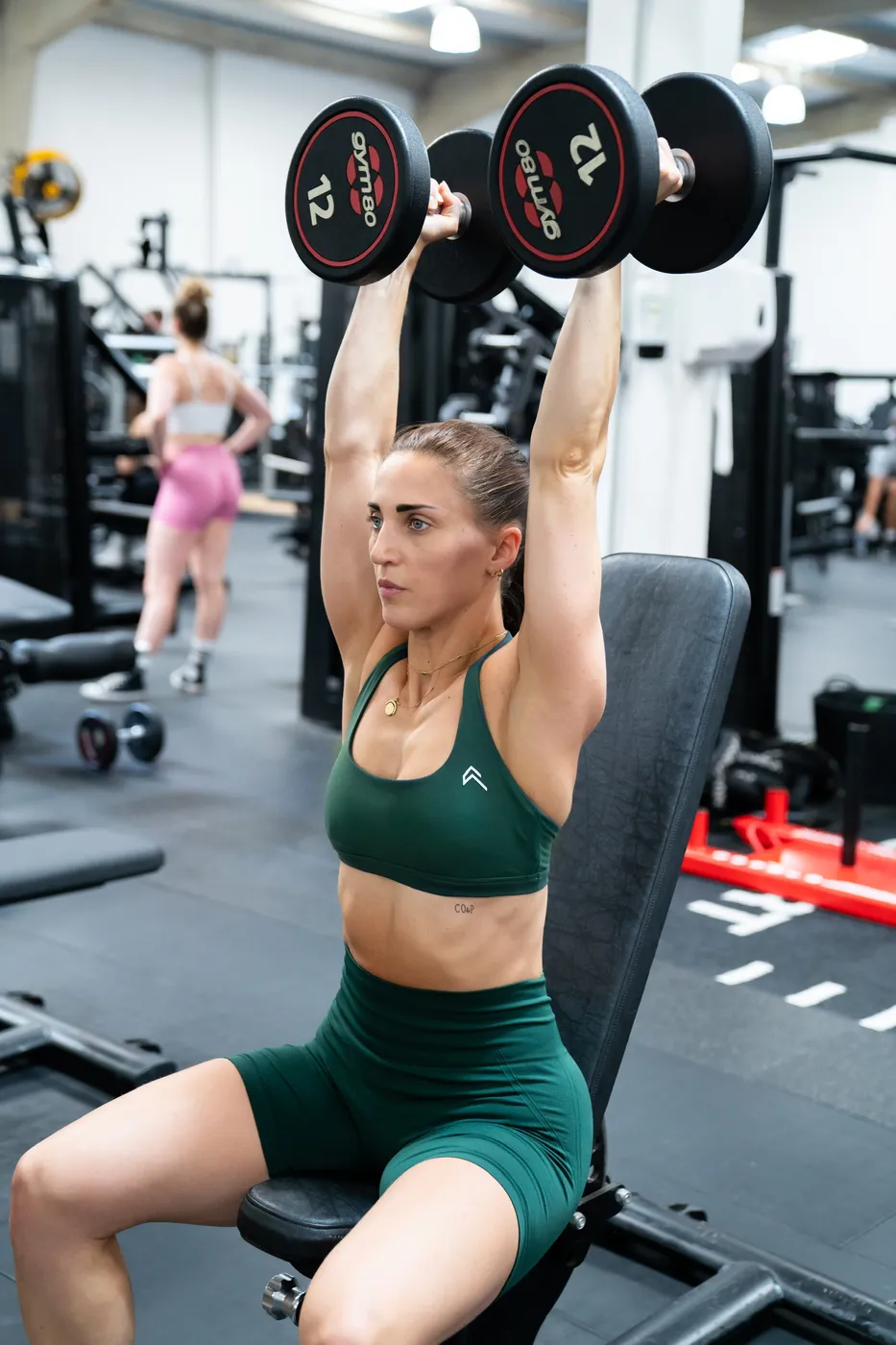
| Push | Seated dumbbell shoulder press | Seated dumbbell shoulder press | 2 sets of 10 to 12 | 3 sets of 10 to 12 | 3 sets of 8 to 10 |
| Pull | One arm dumbbell row | Lat pulldown | 2 sets of 10 to 12 | 3 sets of 10 to 12 | 3 sets of 8 to 10 |
| Carry | Carry two heavy shopping bags or dumbbells | Farmer’s carry with dumbbells | 2 walks of 30 seconds | 3 walks of 30 seconds | 3 walks of 40 seconds |
Warm up for five minutes first, with a brisk walk, a bike or a few bodyweight squats. Rest 60 to 90 seconds between sets. A session takes about 30 to 40 minutes.
How heavy should the weights be?
Heavy enough that the last two or three reps of each set feel hard, while your form stays good.
The ACSM position stand recommends beginners use a load they can lift 8 to 12 times. In practice, if you can do more than 12 reps with no effort, the weight is too light. If your form breaks down before 8, it is too heavy.
In weeks 1 to 4, start lighter than that while you learn each movement. That is the stage where good habits are made.
How do you progress a beginner strength plan?
Add reps first, then weight. This is called progressive overload, and it is how your body keeps getting stronger.
- Pick a weight you can lift for the bottom of the rep range, for example 10 reps.
- Each session, try for one more rep on each set.
- When you can do the top of the range on every set with good form, go up to the next weight.
- Drop back to the bottom of the range with the new weight and build up again.
The ACSM suggests raising the load by 2 to 10% once you can do one or two reps more than your target. With dumbbells, that usually means the next pair up. Write every session down, in a notebook or an app, so you always know what to beat.
Can you do this plan at home without a gym?
Yes. Every exercise has a home version, and the UK guidelines count body weight and resistance bands as strengthening activity.
For the first few months, a resistance band and two or three pairs of dumbbells cover the whole plan. Adjustable dumbbells save space. When the heaviest dumbbells you have start to feel easy for 12 reps, slow each rep down or pause at the bottom. After that, a gym makes it easier to keep adding weight.
If the gym is the part you are dreading, our guide to gym anxiety covers what to do before, during and after your first sessions.
Will strength training make women bulky?
No. Building a lot of muscle takes years of focused training and eating for it. A beginner plan like this makes you stronger and changes your shape gradually.
Most women who want to look “toned” want a little more muscle and a little less fat. As Jade puts it, you can’t tone what isn’t there. Lifting builds the muscle. If fat loss is your goal too, read strength training for weight loss, and for the food side, how much protein a woman needs.
How long does it take to see results from strength training?
You will usually feel stronger within a few weeks, as you learn the movements. Visible changes in shape take longer, often a few months of steady training.
Every woman is different, so there is no date to promise. The trials in the ACSM’s 2026 review ran for at least six weeks. The most useful sign early on is your training log: if the reps and weights are going up, it is working.
Who should check with a GP before starting?
Anyone with a heart or blood pressure condition, a recent injury, or who is pregnant or has recently had a baby.
- Pregnant: read lifting weights while pregnant and talk to your midwife.
- After a baby: wait until your GP has checked you, usually at around six to eight weeks. If you have leaking, heaviness in your pelvis or a gap down your stomach, see a women’s health physio and start gently. Our guides to diastasis recti exercises and postpartum belly explain more.
- Over 40 or in menopause: this plan suits you too. Read strength training for women over 40 and the best exercise for menopause for what changes.
- Pain: sharp, sudden or worsening pain is a reason to stop and get checked.
Questions women ask about strength training
What are the big 5 exercises for strength?
They are usually listed as the squat, deadlift, bench press, overhead press and a row or pull-up. This plan uses beginner versions of each, such as the goblet squat and dumbbell Romanian deadlift, so you can learn the patterns before moving to a barbell.
What is the 5 5 5 30 rule?
It is a social media workout format, and versions online do not agree on what it means. It is not part of NHS or UK guidance. For a beginner, two or three full body sessions a week, as above, is the better guide.
Is strength training good for mental health?
The evidence says yes. A review of 16 trials with 922 adults, most of them women, found resistance training reduced anxiety symptoms compared with no exercise (Gordon et al., 2017).
Should I use machines or free weights as a beginner?
Either works. The ACSM’s 2026 review found that the type of equipment did not consistently change results. Use whatever you feel confident with and can progress.
Is a 3 day workout plan better than 2 days for women?
Three gives you more practice and more chances to progress, but two days done every week will still make you stronger. Pick the one you can keep doing.
Can I do this plan if I have PCOS?
Talk to your GP first, especially if you take medication for it. We coach alongside your GP, never instead of them.
Want a plan written for you?
This plan is a good place to start. A coach makes it fit your week, your equipment and your body, and tells you when to move on. At ALTR, your plan is in the app, written for where you train, and the first four to six weeks are spent on form, with your coach checking videos of your lifts on WhatsApp. If getting going again is the hard part, read how to get back into exercise, and see how our one to one coaching works.
When you are ready to start, book your free call with Jade.