
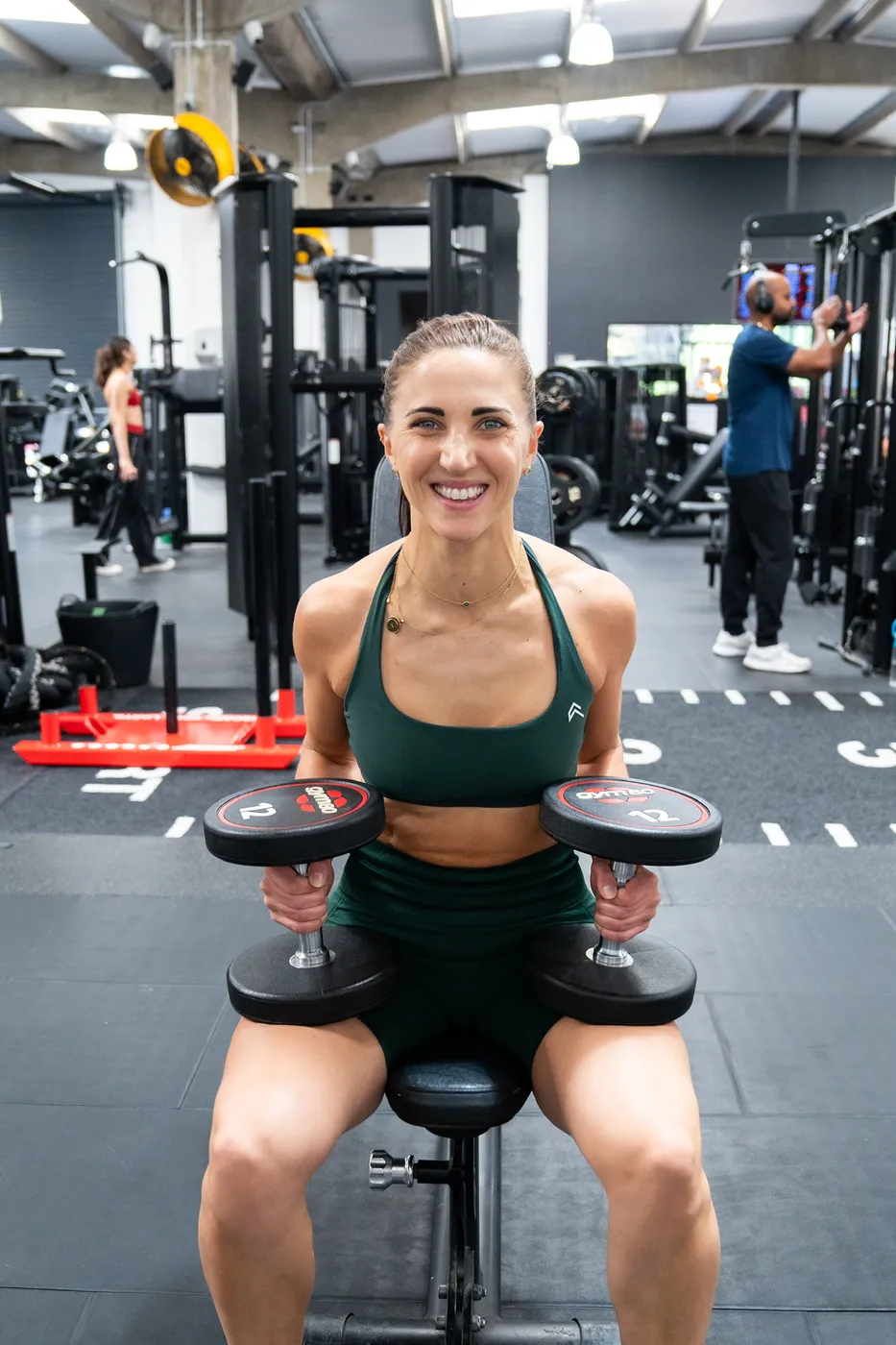
The short answer: gym anxiety is the nervous, watched feeling many women get about walking into a gym, especially for the first time. It eases fastest when you know exactly what you are there to do. Write your session down before you go, pick a quiet time, start with four or five simple exercises, and learn them at home first if that feels better.
If you have joined a gym, paid for the membership and still not managed to walk through the door, you are far from the only one. This guide covers what gym anxiety is, what to do before, during and after your first sessions, and why training at home first counts as a proper start.
What is gym anxiety?
It is the worry about being judged, getting something wrong or not knowing what to do in a gym.
For some women it is a knot in the stomach in the car park. For others it means doing ten minutes on the treadmill and leaving, because the weights area feels like it belongs to other people. It is a normal reaction to a new place full of equipment you have never used, often in front of people who look like they know what they are doing.
Is gym anxiety normal for women?
Yes. It is one of the most common reasons women give for not exercising.
When Sport England launched This Girl Can in 2015, its research found that 75% of women said they wanted to be more active, and that fear of judgement on appearance or ability was one of the main things holding them back. Women are still less active than men in England: in Sport England’s Active Lives survey for November 2024 to 2025, 62.2% of women were active for 150 minutes or more a week, compared with 67.3% of men.
So the feeling is common, and it says nothing about whether you belong in a gym.
Why does the gym give me anxiety?
Usually because of three things: not knowing what to do next, feeling watched, and worrying about doing an exercise wrong.
The first one is the biggest, and the easiest to fix. Standing in the middle of a gym trying to decide what to do is where the panic tends to start. Once you have a written plan, you are no longer deciding on the spot. You are just doing the next thing on the list.
How do you overcome gym anxiety as a beginner?
Have a plan, start small and go back often. Confidence comes from repeating the same few sessions until they feel familiar.
Here is what helps at each stage.
| When | What to do | Why it helps |
|---|---|---|
| Before you go | Write your session down: four or five exercises, sets and reps | No “what do I do next” moment |
| Before you go | Practise the moves at home with a dumbbell, a band or body weight | You already know how they feel |
| Before you go | Pick a quiet time, such as mid-morning or later in the evening | Fewer people, free equipment |
| Before you go | Book an induction, or ask staff to show you the machines | Someone has already shown you where things are |
| During | Start with the equipment you know, in a corner you like | A familiar spot settles you |
| During | Keep headphones in and your plan on your phone | Your attention stays on your session |
| During | If a machine is taken, swap to a dumbbell version of the same move | No standing around waiting |
| After | Write down what you lifted and how it felt | Proof you are getting stronger |
| After | Book your next session before you leave | The second visit is easier than the first |
What should you do before your first gym session?
Decide everything at home, so there is nothing left to decide in the gym.
- Write your plan. Choose one exercise each for your legs, the back of your legs, pushing, pulling and your core. Two sets of 10 to 12 reps each is plenty for a first session. Our beginner strength training plan for women sets this out week by week.
- Practise at home. A goblet squat, a glute bridge, a push-up against the kitchen worktop and a band row will all transfer straight to the gym.
- Watch the gym first. Many gyms let you look round before you join. Notice where the dumbbells, benches and cable machines are.
- Pack the night before. Water, headphones, a towel and your plan on your phone.
What should you do during your first gym session?
Follow the plan, keep the weights light and leave when it is done.
Warm up for five minutes on a bike or a cross-trainer. Then work through your list in order, resting a minute or so between sets. Pick weights that feel easy for the first week. The aim is to learn the route round the gym and the feel of each move, and to leave thinking “that was fine”.
Most people in a gym are thinking about their own session. If you notice someone looking, they are usually waiting for the equipment you are on. It is fine to say “I’ve got two sets left” and carry on.
What should you do after your first gym session?
Write it down and book the next one.
Note each exercise, the weight and how many reps you managed. Next time, you are just repeating that list, and soon you will add a rep or a little weight. That written record is what turns the gym from somewhere new into somewhere you go.
Can you start at home if the gym feels like too much?
Yes. Training at home counts, and it is a sensible way to build confidence before you ever set foot in a gym.
The UK Chief Medical Officers’ physical activity guidelines say adults should do muscle strengthening activities on at least 2 days a week, using all the major muscle groups. They list body weight, free weights, resistance machines and elastic bands, and add that “any strengthening activity is better than none”.
A few dumbbells and a band at home will take you a long way. Many women train at home for months, learn the movements properly, and then move to the gym when they want heavier weights. Others stay at home for good. Both are a real start.
Does gym anxiety go away?
For most women it fades with repetition. The fourth visit with the same plan feels very different from the first.
It helps to measure progress by how many sessions you have done, and to stop judging how relaxed you felt. If you have been three times this week, you have done what you set out to do, nerves and all.
Can strength training help with anxiety?
The research suggests it can. A review of 16 trials with 922 adults, about two thirds of them women, found that resistance training reduced anxiety symptoms compared with no exercise (Gordon et al., 2017).
The NHS says regular exercise can boost your mood if you have depression. If anxiety or low mood is affecting your daily life, see your GP as well. Exercise works alongside proper support.
Questions women ask about gym anxiety
How common is gym anxiety?
Very common. There is no single UK figure for gym anxiety itself, but Sport England’s research has named fear of judgement as one of the main reasons women are less active than they want to be.
What should I do on my first time at the gym as a woman?
Go at a quiet time with a written plan of four or five exercises, use light weights, and book your next visit before you leave. Ask for an induction if your gym offers one.
How do I exercise when I feel anxious or low?
Start small. A ten minute walk or one short home session counts. The UK guidelines say small bouts of activity, even under ten minutes, add up over the day and the week. See your GP if your mood has been low for a while.
Is it OK to go back to the gym after having a baby?
Yes, once you are ready, but start gently. If you have leaking, heaviness in your pelvis or a gap in your stomach muscles, see your GP or a women’s health physio first. Our guides to postpartum belly and diastasis recti exercises explain more. If you are pregnant, read lifting weights while pregnant.
Should I start at home or in the gym?
Wherever you will actually go. If the gym feels too much right now, start at home, learn the moves and move to the gym later if you want to.
Training with a coach
Having a plan removes most of the “what do I do next” panic, and having someone check your form removes most of the rest. At ALTR, your plan is written for where you train, at home or in the gym, and the first four to six weeks are spent on form. You send videos of your lifts to your coach on WhatsApp, and you message as often as you want. Read about our one to one coaching, and if your motivation is the harder part, our guide on how to motivate yourself to work out may help.
When you are ready, book your free call with Jade.