
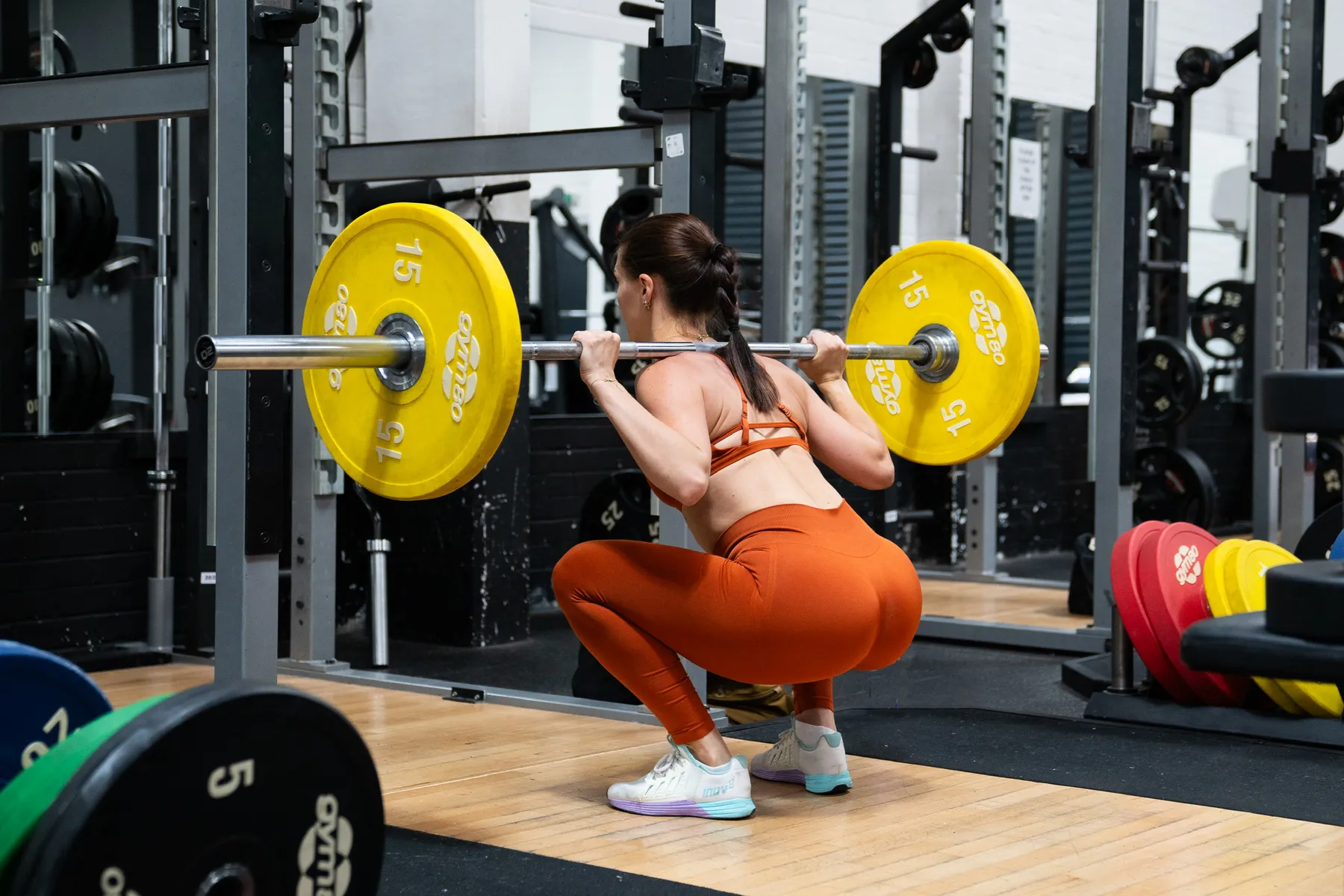
If you feel like your body burns less than it used to, the most reliable way to speed up your metabolism is to build muscle. Muscle at rest uses about 13 calories per kilo a day, and fat uses about 4.5 (Wang et al., 2010). Strength training, enough protein, moving more through the day and good sleep do the rest.
What is your metabolism, really?
Your metabolism is all the energy your body uses in a day. It has three main parts.
- Your basal metabolic rate (BMR). This is the energy your body uses at rest, to breathe, keep your heart beating and repair itself. It is the biggest part for most women.
- Movement. That is your workouts plus everything else: walking to school, standing at the sink, carrying shopping. Researchers call the everyday part NEAT, short for non-exercise activity thermogenesis.
- Digesting food. Breaking down what you eat uses a small amount of energy too.
So when people say “speed up your metabolism”, they mean raising one or more of those. Some are easy to change. Some barely move.
Does strength training speed up your metabolism?
Yes. Strength training is the lever with the best evidence behind it.
One review of resistance training found that ten weeks of it may add 1.4 kg of lean weight, raise resting metabolic rate by 7% and take off 1.8 kg of fat (Westcott, 2012). That is the whole package: more muscle, less fat, and a body that uses more at rest.
Be honest with yourself about the size of it, though. Using the figures above, 1.4 kg of new muscle uses roughly 18 extra calories a day at rest. Useful, and it adds up over years. The bigger win is what muscle lets you do. Stronger legs make walking, stairs and lifting your children easier, so you move more without thinking about it. And muscle you keep now is muscle you don’t lose later.
The UK guidelines already ask for this. Adults should do strengthening activities that work all the major muscle groups on at least 2 days a week, alongside 150 minutes of moderate activity (NHS physical activity guidelines).
If you want the full picture on how lifting changes your body shape and weight, read strength training for weight loss.
How much does everyday movement matter?
More than most women expect. The energy you use outside of workouts can differ between people of the same weight by up to 2,000 calories a day (Levine, 2006).
That gap comes from ordinary things. A job on your feet, walking the school run, taking the stairs, pacing on phone calls. One workout can’t make up for the rest of the day sat down.
A few simple ways to raise it:
- Walk somewhere you would normally drive, once a day.
- Stand for phone calls.
- Keep a step count and nudge it up week by week, rather than chasing a big number on day one.
Does protein help your metabolism?
Yes, in two ways. Your body needs protein to build and keep the muscle that strength training asks for. And higher-protein meals leave people feeling fuller, which helps when you are trying to change how you eat (Leidy et al., 2015).
How much you need depends on your weight and how much you train. We have worked it out per kilo in how much protein does a woman need.
Does sleep affect your metabolism?
Sleep affects almost everything that drives it. Tired women move less, train with less effort and reach for quicker food. If your nights are broken by children or night sweats, protect what you can: a regular bedtime, a dark room and caffeine earlier in the day.
Does your metabolism slow down after 40?
Much less than you have been told. A large study of daily energy use across the whole lifespan found that daily energy use, adjusted for body size, stays stable from 20 to 60 and only starts to fall after 60 (Pontzer et al., 2021).
So what changes in your 40s is usually not your metabolism on its own. It is the muscle you have, how much you move, how you sleep and how busy life has become. All of those can be worked on.
Can you speed up your metabolism during perimenopause or menopause?
You can do the same things that work at any age, and they matter more. Hormone changes in perimenopause can affect sleep, energy and where your body stores fat. Building and keeping muscle is the part you control. Natalie, one of our coaches, is a menopause exercise specialist, and our menopause coaching page explains how plans change at this stage. For more on the weight side, read perimenopause weight gain.
What about after undereating?
If you have been eating very little for a long time, eating enough is part of the fix. Your body needs fuel to train, recover and build muscle. A plan that starts with what you really eat, and builds from there, is safer than cutting harder. If you have a history of disordered eating, talk to your GP before changing how you eat.
What doesn’t speed up your metabolism much?
Most of what is sold for it. Teas, pills and “fat-burning” foods promise a lot, and none of them builds muscle. Skipping meals doesn’t help either. The things that work are the plain ones in the table below.
| What you can change | How much it helps | How to start |
|---|---|---|
| Strength training | Builds muscle, which uses about 13 calories per kilo a day at rest against 4.5 for fat | 2 or 3 full-body sessions a week |
| Everyday movement | Can differ by up to 2,000 calories a day between people | More walking, more standing |
| Protein | Supports muscle, and helps you feel full | Some protein at every meal |
| Sleep | Shapes energy, training and food choices | A regular bedtime |
| Caffeine | Small and short-lived | Not worth chasing |
| Teas, pills, “fat burners” | Very little | Skip them |
Should you see a GP about a slow metabolism?
See a GP if something feels wrong. Symptoms like extreme tiredness, feeling cold more than usual, putting on weight, low mood and dry skin or hair can be signs of an underactive thyroid (NHS). That needs a blood test, not a training plan. The same goes for PCOS or any medication you think is affecting your weight. We coach women with these conditions alongside their GP, never instead of them.
Your questions about metabolism
What burns fat while sleeping?
Your body keeps using energy all night, through your basal metabolic rate. There is no food or drink that makes it burn fat while you sleep. More muscle and good sleep are what help.
What is basal metabolic rate?
Your basal metabolic rate is the energy your body uses at complete rest, just to keep you alive. It is usually the largest part of the energy you use each day. More muscle raises it a little.
Does caffeine speed up metabolism?
A little, and only for a short time. In one study, 100 mg of caffeine raised resting metabolic rate by 3 to 4% for about two and a half hours (Dulloo et al., 1989). It is not a plan. Too much caffeine also gets in the way of sleep.
What are signs of slow metabolism?
Feeling tired all the time, feeling cold and gaining weight without changing what you eat are often put down to a slow metabolism. They are also signs of an underactive thyroid, so see your GP if they sound like you.
What foods speed up metabolism?
No single food makes a real difference. Eating enough protein supports the muscle you build, and that is what moves the needle.
Where to start this week
Pick two days and do a full-body strength session on each. Add a walk on the days in between. Put some protein on every plate. That is the base we build every ALTR coaching plan from, written around your week, your body and the equipment you have.
If you want a plan written for you, book your free call with Jade.